
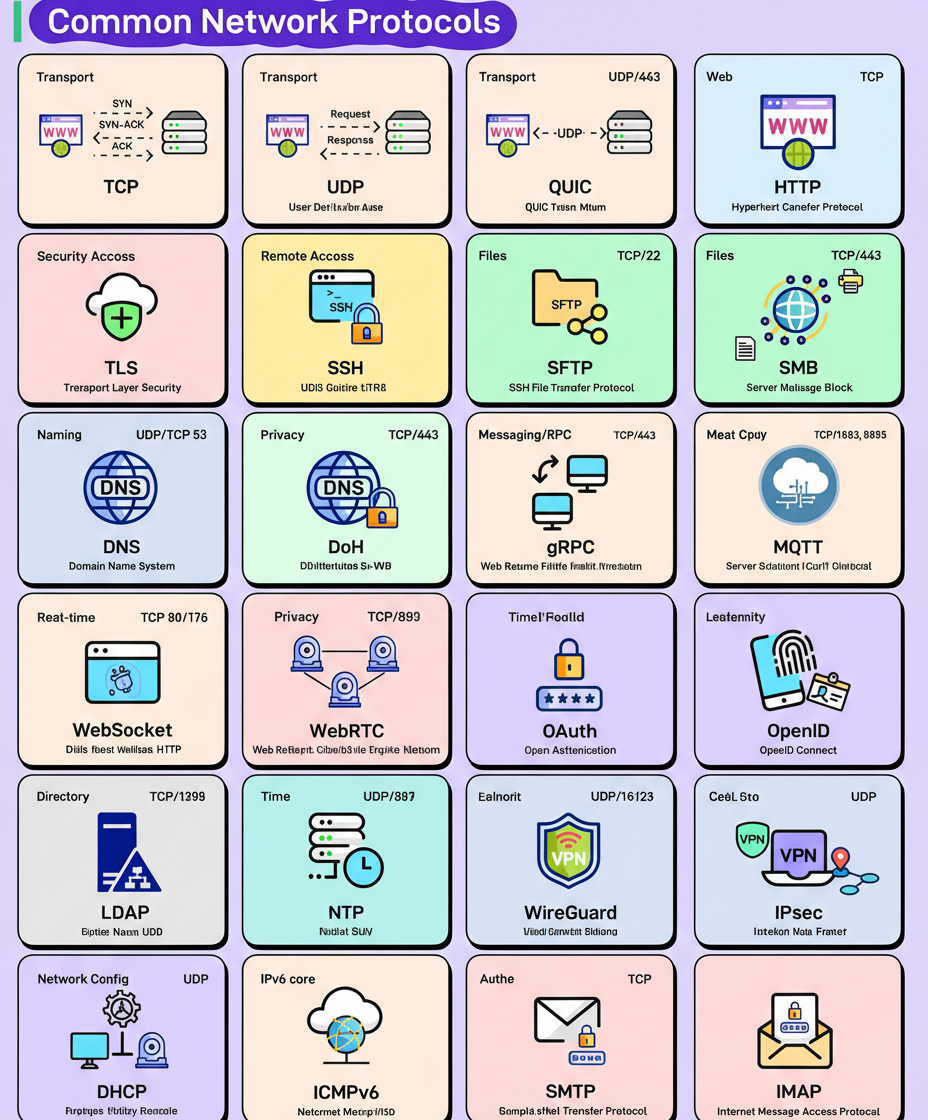
Every interaction on the internet, whether sending an email or joining a video call, depends on network protocols. These protocols dictate how data is transmitted, who is authorized to communicate, and how security is maintained.
At the core, transport protocols include TCP, which guarantees reliable delivery; UDP, which prioritizes speed; and QUIC, which blends both aspects using UDP. On top of these, HTTP facilitates web access, TLS ensures security, and DNS translates domain names to IP addresses.
For remote access, SSH is utilized, while file transfers rely on SFTP or SMB. Real-time communications such as chat and media streaming use protocols like WebSocket, WebRTC, and MQTT to maintain live data flow.
Identity and access management depend on OAuth and OpenID for authorization and authentication.
In backend operations, protocols such as DHCP, NTP, ICMPv6, and LDAP ensure synchronization, addressing, and discovery processes run smoothly.
These protocols span from basic email transmission with SMTP and IMAP to securing networks with encrypted VPN solutions like WireGuard and IPsec, forming a critical infrastructure that connects and secures the internet.
A question arises: which protocol’s worldwide failure would most critically disrupt internet functionality?
Network protocols serve as the foundation for data transfer between two systems within a network.
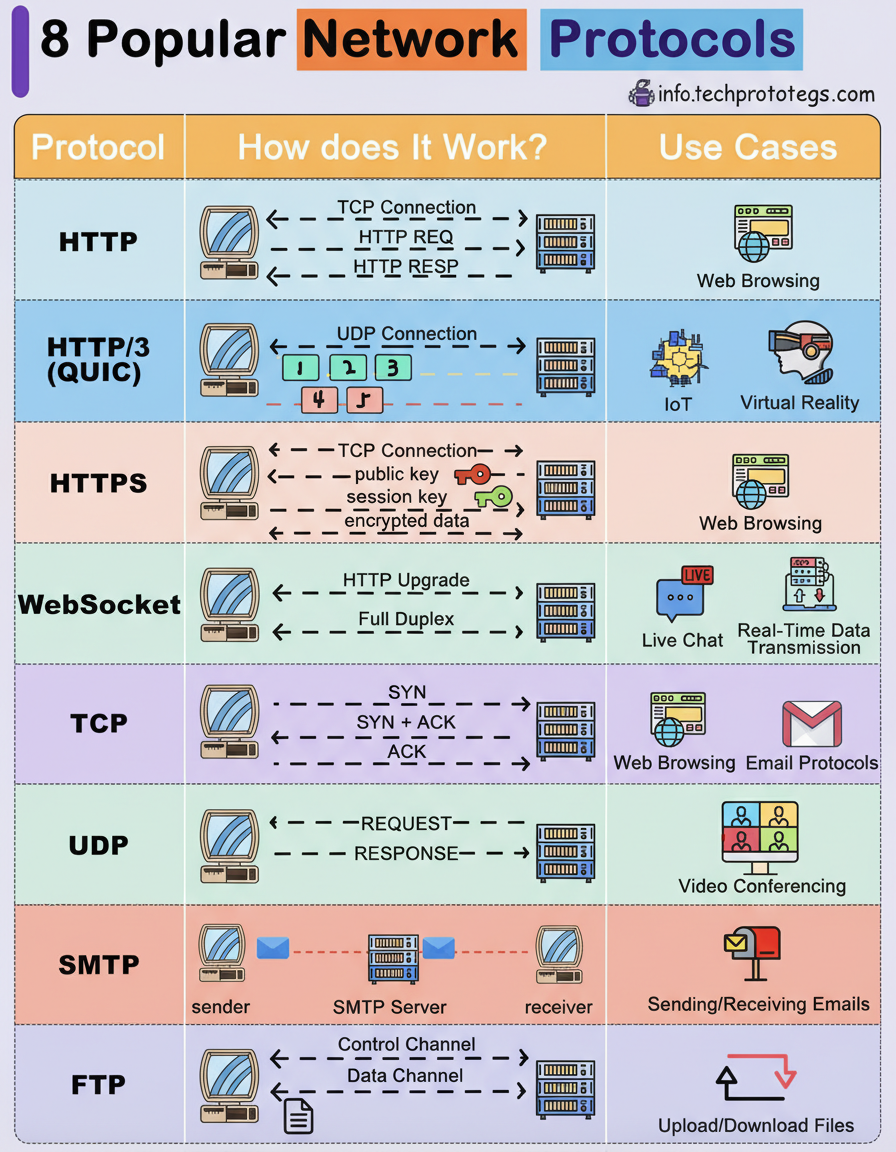
FTP (File Transfer Protocol) operates using separate control and data channels for uploading and downloading files between clients and servers.
TCP (Transmission Control Protocol) establishes a reliable connection through a three-way handshake (SYN, SYN+ACK, ACK) to ensure accurate data delivery.
UDP (User Datagram Protocol) transmits lightweight, connectionless packets with minimal latency, optimal for fast communication needs.
HTTP (HyperText Transfer Protocol) utilizes TCP to request and receive web resources such as HTML pages and images via HTTP requests and responses.
HTTP/3 (QUIC) is built on UDP and enables faster, more dependable connections by multiplexing data streams and reducing latency.
HTTPS (Secure HTTP) protects web communications by encrypting HTTP using public and session keys over TCP.
SMTP (Simple Mail Transfer Protocol) manages the transfer of emails from a sender to a recipient through SMTP servers and is commonly used for email delivery.
WebSocket enhances an HTTP connection by upgrading it to a full-duplex channel, enabling real-time, bidirectional communication such as live chats.

Developing microservices involves adherence to key best practices, including: